
By Virginie Nguyen Hoang
reporting from Kherson specially for Novynarnia
The term “human safari” dates back to the 1990s during the Bosnian War, when, according to witness accounts, Serbian forces allegedly accepted payments from wealthy foreigners for the opportunity to shoot at civilians trapped in the besieged city of Sarajevo.
In Ukraine, the term came into use in 2024 as Russian drone attacks against civilians in the Kherson region intensified. A year later, the UN Independent International Commission of Inquiry on Ukraine concluded that these attacks amounted to war crimes and acts of terror, and “suggest a coordinated state policy, on the part of the Russian authorities, to force the population to leave”.
Yet Russia continues to terrorize the local population. In this report, Novynarnia examines how the residents of Kherson are adapting to the constant threat posed by Russian drones.
Ukrainian version of the article read here.
In a room at Kherson Regional Hospital in southern Ukraine, 55-year-old Mykola looks anxiously at his wife lying on her side. Her eyes are red and swollen, her face bears dozens of stitches, and her lips are badly bruised. Larysa is still struggling to recover from the shock. “She was on the marshrutka that was attacked by a Russian drone on July 9,” her husband explains. “She suffered a broken nose, a concussion and severe hearing loss. She can only hear if someone speaks very close to her ear,” he says with a sigh.
51-year-old Larysa works as a laboratory technician. She was returning home from Dniprovskyi District Hospital, where she is employed. She was fully aware of the risks: the hospital is located in the southern part of the city, an area that is regularly targeted by Russian drones. But she had no alternative. “We don’t own a car. The buses are our only means of transportation,” Mykola says helplessly.
In the same room, 53-year-old Liudmyla is also confined to a hospital bed. Her face, arms and legs are covered in traumatic tattoos, the tiny black marks left when fragments of metal become embedded beneath the skin during an explosion. “After finishing work, I boarded bus 47, the only route that takes me home. Suddenly there was a huge explosion. I never saw the drone coming. I lost consciousness, and when I woke up there were paramedics and ambulances all around me,” she recalls.

Liudmyla, 53, lies in her hospital bed recovering a Russian drone attack. Credit: Virginie Nguyen Hoang
Like Larysa, Liudmyla works at Dniprovskyi Hospital, where she sterilises medical equipment. Despite the trauma, she says she intends to return to work as soon as she has recovered. “I’m frightened, but I have no other choice than to take the bus. I have to keep earning a living so I can support my parents and avoid becoming a financial burden on my daughter.”
Since mid-2024, Russian forces entrenched on the eastern bank of the Dnipro River in the Kherson region have launched what local residents now refer to as a “human safari”: a sustained campaign of attacks using FPV (First Person View) kamikaze drones. Initially, these strikes mainly targeted civilians travelling along the Ukrainian-controlled western bank of the river. Gradually, however, the attacks spread into the city centre. Today, buses and trolleybuses, still heavily relied upon by the roughly 65,000 residents who have remained in Kherson, have become some of the drones’ primary targets. According to the city authorities, attacks on public transport have so far killed four people and injured at least 32 others in July alone.

On July 1, a Russian drone struck a marshrutka in Kherson, killing three people and injuring 11 others. Credit: Kherson City Military Administration
In the room next to Liudmyla’s, 61-year-old Anatoly, the driver of bus 47, lies seriously injured. His wife, Oksana, is still in shock. “He can barely speak. His entire body is covered in shrapnel wounds,” she says before adding firmly: “He will never go back to work. We used to argue every morning because this very bus route had already been attacked last month.”
Upstairs, 40-year-old Angela is preparing to return home to collect a few belongings. Her jeans are still stained with blood, while the traumatic tattoos on her face remain only partially concealed beneath layers of makeup. The deputy director of an NGO, Angela was also on bus 47. “I was sitting in the third row. I never saw it coming. There was an explosion, I lost consciousness, and when I came to, I found myself lying at the back of the bus.”
As emergency crews were tending to the wounded, Angela says a second drone appeared overhead before being shot down by Ukrainian soldiers armed with shotguns. She suffered a serious eye injury and will undergo surgery in Odesa to remove a shard of glass lodged behind her eyeball. “Once I’ve completed my rehabilitation, I won’t take the bus anymore. From now on, I’ll work remotely from my laptop.”

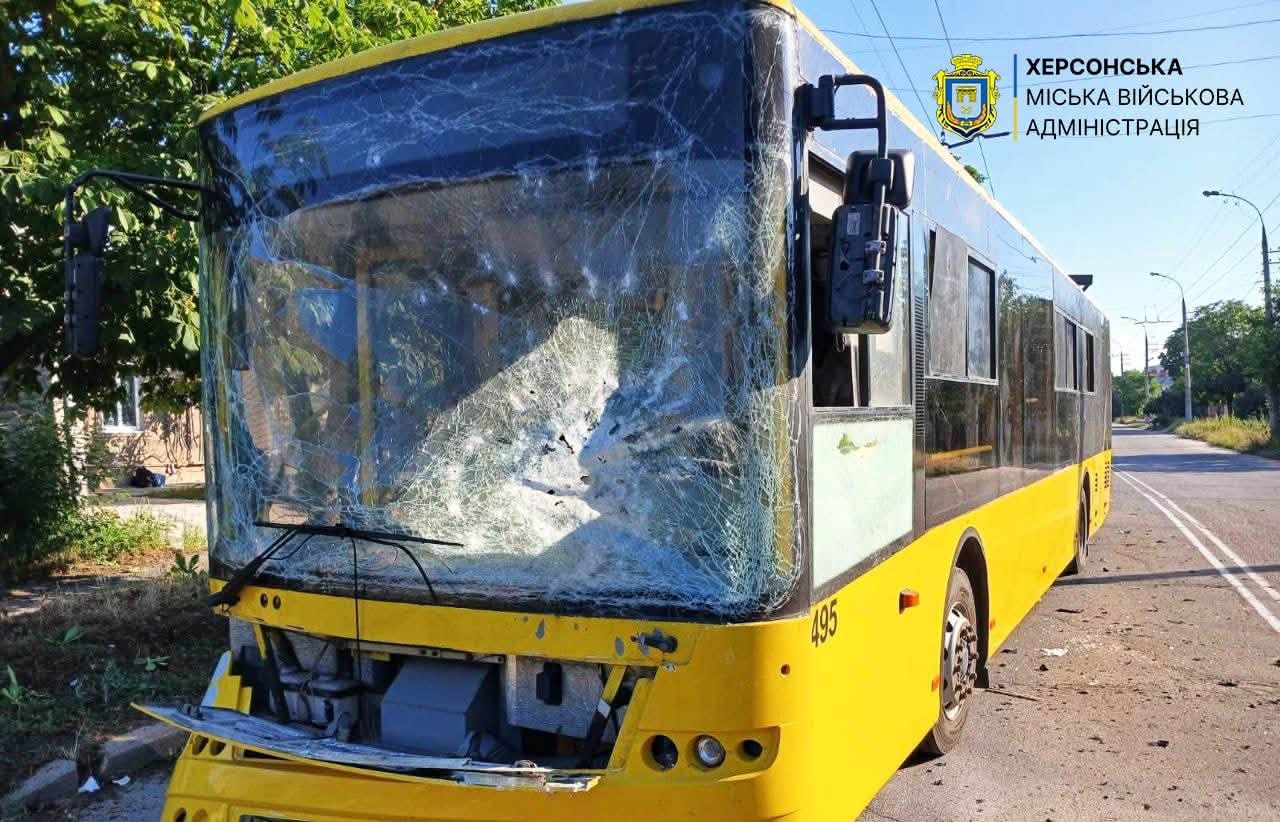
Damage to a bus caused by a Russian drone. Fortunately, the driver managed to escape and no passengers were in the bus. Credit: Virginie Nguyen Hoang
In Tavriiskyi district, in the northern part of the city, the yellow, pale blue and white marshrutkas continue to circulate as though nothing had happened. Every ten minutes, they pull into bus stops now protected by anti-drone netting and reinforced shelters. A little further east, residents arrive on foot across an empty field, walking past a church whose liturgical chants contrast sharply with the thick plume of smoke rising from a Russian bombardment in the neighbouring district.
Serhiy and Lidia, a couple in their forties, have just arrived from Tekstylnyi district. The bus line serving their neighbourhood has not operated since March, when a Russian drone struck a minibus, injuring 20 passengers. “It was the last bus that still went to Tekstylnyi. Since then, we’ve had to walk for 20 minutes under the constant threat of drones just to reach the nearest bus route,” Serhiy explains. His wife laughs before adding: “We don’t walk, we run!”
At the bus stop, 40-year-old Pavlo has just pulled up behind the wheel of his minibus, operated by a private company under contract with the city. Wearing a bulletproof vest, he says that hardly a day goes by without a vehicle coming under attack. “I’ve already survived four direct drone strikes. The first time, as soon as I spotted the drone, I stopped the vehicle and shouted at the passengers to get out as quickly as possible. The drone exploded a few seconds later, and the bus was completely engulfed in flames. I was in shock.”

Pavlo, a 40-year-old bus driver, wears a bulletproof vest. Credit: Virginie Nguyen Hoang
Before setting off again, equipped with a drone detector provided by volunteers, Pavlo explains that he continues doing this job because there are few professional alternatives left in Kherson. “My wife wants me to quit. But driving a marshrutka is like a virus,” he says with a laugh. Every day, Pavlo drives Route 7 to Korabelna Square before turning back, as Korabel Island has become one of the most dangerous areas of Kherson. So far, he has “only” suffered a concussion in drone attacks on his vehicle, despite earning no more than 700 hryvnias a day.
While Pavlo works for a private operator, the city’s main public transport provider remains the Kherson Municipal Transport Company. Valery, 60, has been driving buses there for years. “I’ve survived seven attacks in the past two years. The windows on my bus have been replaced countless times. But it’s my duty to keep transporting the people of Kherson” he says.
Unlike Pavlo, Valery does not wear body armour. Instead, he has completed several first-aid training courses organized by the municipality. On board his bus are Zahar and Viktor, two teenagers carrying first-aid kits. “We’re not afraid,” says 17-year-old Viktor proudly. “If we’re attacked, we know exactly what to do. You have to get off immediately because a second drone often arrives just after the first one. And if someone is injured, we’ve learned how to provide first aid.”
Not everyone feels as prepared. “If something happened, I honestly wouldn’t know how to react,” says 40-year-old Anya as she waits for a bus in Tavriiskyi district to return home. She works two jobs, during the week in a warehouse and on weekends in a grocery store, to earn enough to support her family.
Originally from Antonivka, Anya and her family were forced to evacuate, and their home was completely destroyed. They have since found new accommodation in Kherson. “I take the bus to work every single day because I don’t have any other option. It’s the same for my husband and for my 16-year-old son whenever they need to go somewhere,” she explains before pausing. “One day I heard an explosion just behind the bus. Fortunately, no one was hurt, but I was so terrified that I couldn’t even bring myself to turn around.”
To better protect residents, the city of Kherson has installed anti-drone netting above large sections of its road network. “But nothing is one hundred percent effective against drones,” acknowledges Vadym Melnyk, Director of the Kherson Municipal Public Transport Company. “We plan to equip buses with tablets connected to Telegram channels that issue real-time alerts whenever drones are detected nearby. The municipality has also promised to supply electronic warfare systems capable of jamming drones, and we will install protective safety film on bus windows to reduce injuries caused by flying glass in the event of an explosion.”
The city also tested anti-drone cages similar to those fitted to some Ukrainian military vehicles. However, they proved too bulky for Kherson’s streets and were ultimately abandoned.
In mid-July, Vadym Melnyk reported that “over the previous month, Russian attacks had damaged 31 public transport vehicles in Kherson—10 buses and 21 trolleybuses.” To improve emergency response, every driver now undergoes first-aid training with the Ukrainian Red Cross every three months.
Even so, some parts of the city are no longer served by public transport. “We haven’t cancelled any routes,” Melnyk explains. “We’ve simply shortened them for safety reasons.” He pauses for a moment before delivering a stark assessment that every resident of Kherson understands all too well. “There isn’t a single safe road left in Kherson.”
〉〉 Вподобали статтю? Найкращий лайк - переказ 50, 100, 200 грн. для гонорарів авторам "Новинарні". Наші рахунки – тут.
〉〉 Кожен читач "Новинарні" має змогу налаштувати щомісячний переказ на довільну суму через сервіс Patreon - на підтримку редакції.
Ми виправдовуємо довіру!